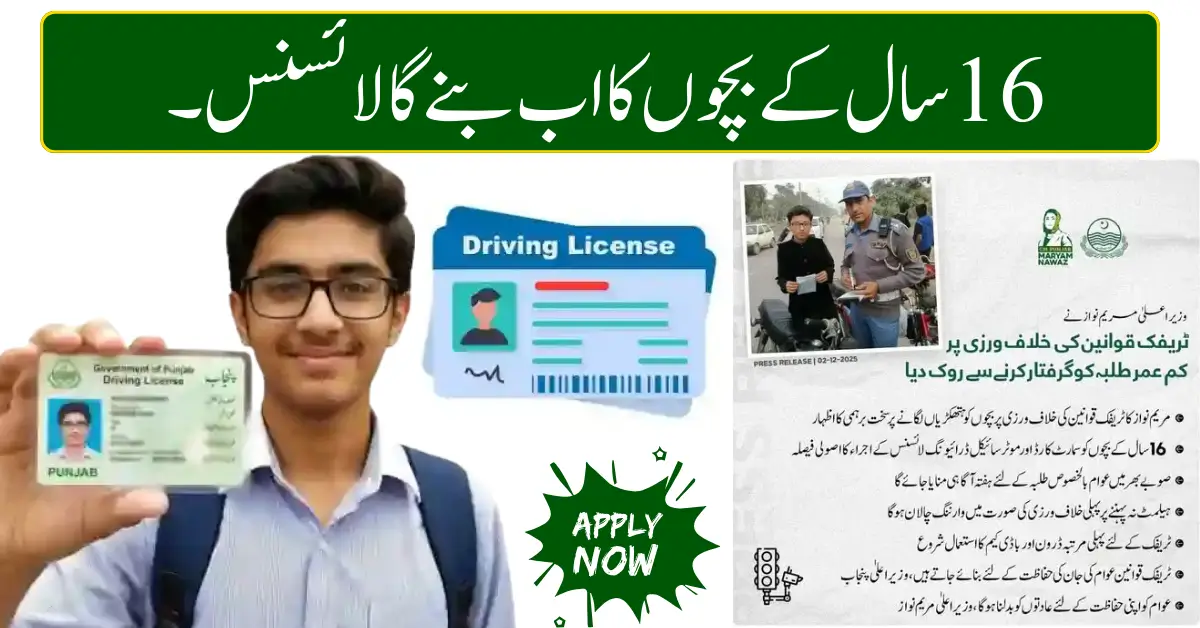
Punjab has taken a historic step in reshaping its traffic and road safety framework by officially allowing 16-year-olds to obtain motorcycle driving licenses. This decision marks one of the most significant reforms in Pakistan’s traffic laws, directly impacting students, young riders, parents, and enforcement authorities across the province.
The policy comes after widespread public debate, criticism of strict enforcement actions, and growing concerns about student arrests during traffic crackdowns. By legalizing motorcycle licenses for minors under controlled conditions, the Punjab government aims to balance road safety, youth responsibility, and humane law enforcement.
What Has Changed in Punjab’s Traffic Policy
Under the updated traffic framework, eligible teenagers can now ride motorcycles legally instead of facing penalties for unlicensed driving. The reform introduces structured licensing, education-based enforcement, and technology-driven monitoring.
Key Changes Introduced
- Motorcycle licenses are allowed for 16-year-old residents of Punjab
- Issuance of learner permits and smart card licenses
- No handcuffing or criminal records for minors
- Shift from punishment to traffic education and awareness
- Digital monitoring through modern surveillance systems
This move is aligned with Punjab’s broader governance reforms in transport, public safety, and digital services.
Why Punjab Approved Motorcycle Licenses for 16-Year-Olds
The decision was driven by public reaction to a province-wide traffic enforcement drive that highlighted serious gaps in the system.
What Triggered the Policy Shift
- Thousands of traffic challans were issued in a short period
- A large number of students were penalized for riding without licenses
- Social media footage showing minors detained for helmet violations
- Strong backlash from parents, educators, and civil society
Many families raised concerns that early criminal records could negatively affect students’ education, employment, and future opportunities. The provincial leadership responded by opting for reform rather than rigid enforcement.
End of Harsh Measures Against Minors
One of the most important changes under the new policy is the prohibition of the harsh treatment of minors during traffic checks.
Updated Enforcement Rules
- No handcuffing of underage riders
- No police lockups for minor traffic violations
- No permanent criminal record for students
- Arrests are only made in rare cases of repeated or dangerous offenses
This approach prioritizes correction, awareness, and long-term safety instead of fear-based compliance.
Helmet Policy Updated for Young Riders
Punjab has also revised how helmet violations are handled, especially for students and first-time riders.
New Helmet Enforcement Approach
- First-time violation results in a warning
- Educational slip issued instead of a fine
- Repeated violations lead to challans
- Awareness sessions replace immediate punishment
The goal is to normalize helmet usage through understanding rather than force.
Technology Now Central to Traffic Monitoring
To improve transparency and reduce misuse of authority, the Punjab Traffic Police has adopted modern monitoring tools.
New Tools in Use
- Drone surveillance for traffic flow and violations
- Body cameras for on-duty traffic wardens
- Digital recording of traffic stops
- Automated challan verification systems
These measures protect both citizens and officers while ensuring fair enforcement.
How 16-Year-Olds Can Apply for a Motorcycle License in Punjab
The licensing process has been designed to be simple, digital, and student-friendly.
Expected Application Process
- Online application through DLIMS Punjab
- Selection of motorcycle category
- Submission of basic identity details
- Low, affordable government fee
- Biometric verification at designated centers
- Issuance of a learner permit
- Road test for a permanent smart card license
Parents or guardians will be involved at verification stages to ensure responsibility and consent.
Role of Parents Under the New Policy
The government has made it clear that parents play a critical role in making this reform successful.
Parental Responsibilities Include
- Ensuring helmet usage at all times
- Discouraging reckless or high-speed riding
- Confirming valid license and documents
- Teaching basic traffic rules at home
- Preventing double riding without safety gear
Authorities see parents as partners in road safety, not bystanders.
Expected Impact on Punjab’s Traffic System
The policy is expected to bring long-term improvements in how young riders interact with the road system.
Positive Outcomes
- Reduction in unlicensed driving
- Better traffic awareness among students
- Fewer arrests and public disputes
- Increased trust in traffic authorities
- Higher license registration rates
Challenges Ahead
- Monitoring compliance among teenagers
- Preventing misuse of licenses
- Ensuring consistent enforcement across districts
Why This Reform Matters Beyond Traffic Laws
This change is not just about motorcycles. It reflects a broader shift in governance toward digital reform, youth inclusion, and citizen-friendly enforcement.
Entities such as Punjab Traffic Police, DLIMS, Punjab Safe Cities Authority, and provincial transport departments are now aligned around education, transparency, and data-driven decision-making.
Frequently Asked Questions
Who can apply for a motorcycle license at 16?
Any Punjab resident meeting documentation and verification requirements.
Will smart cards be issued?
Yes, digital smart card licenses will be mandatory.
Are fines completely removed for minors?
No. Warnings apply initially, but repeat violations will still be fined.
Is this policy active across Punjab?
Yes, implementation has started province-wide.
Does this affect the car driving age?
No, the policy applies only to motorcycles.
Conclusion
Punjab’s decision to allow 16-year-olds to obtain motorcycle licenses represents a progressive shift toward safer roads, responsible youth mobility, and humane traffic enforcement. By combining education, legal access, and technology, the province is setting a new standard for traffic governance in Pakistan.
As the policy rolls out fully in 2026, its success will depend on cooperation between students, parents, traffic authorities, and the wider community—ensuring that safety and responsibility go hand in hand.