
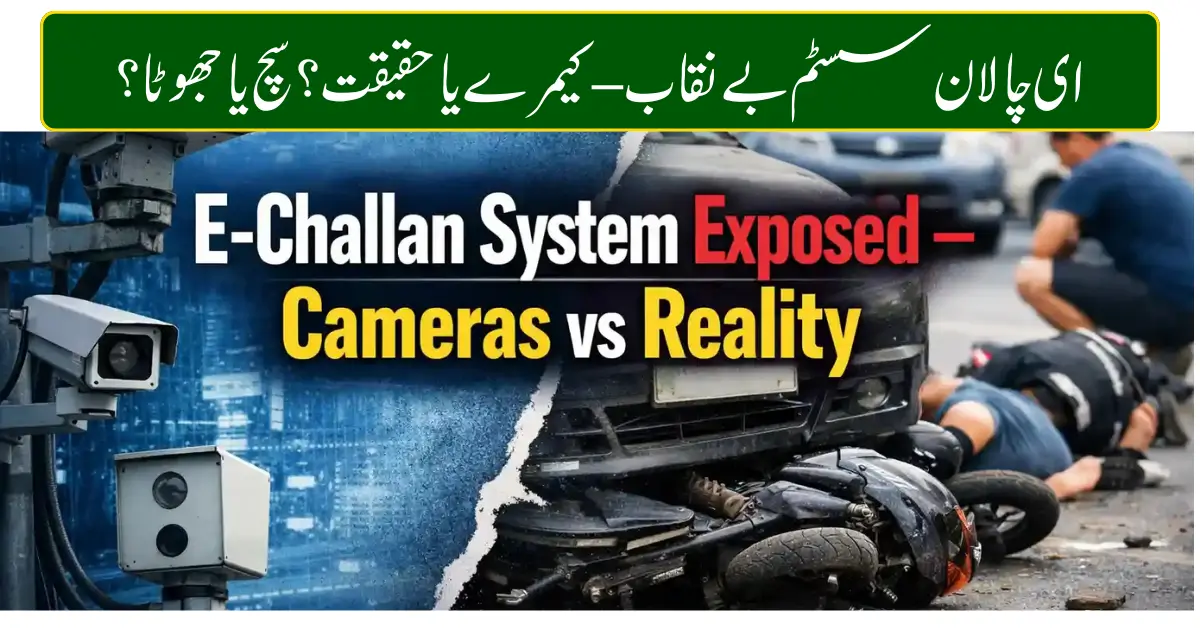
Pakistan’s E-Challan system was launched with big promises: safer roads, corruption-free enforcement, and faster handling of traffic violations. Powered by surveillance cameras, Automatic Number Plate Recognition (ANPR), and centralized digital databases, the system was meant to modernize traffic management across major cities.
By 2026, E-Challan cameras are everywhere — on highways, intersections, flyovers, and busy urban roads. Yet public frustration is rising. Drivers increasingly question whether camera-based enforcement reflects what truly happens on the road.
This article explores the gap between camera footage and ground reality, highlighting how the E-Challan system works, where it succeeds, where it fails, and what must change for fair digital policing.
Understanding the E-Challan System
The E-Challan system is an electronic traffic violation platform that automatically detects and records offenses without physical interaction between drivers and traffic wardens.
It operates through a network of:
- High-definition surveillance cameras
- ANPR software
- Central traffic police databases
- Online verification and payment portals
- SMS and postal notification services
Authorities such as the Punjab Traffic Police, the Islamabad Traffic Police, and the Sindh Traffic Police use this infrastructure to issue digital fines.
What the Technology Claims to Do
According to official statements, the system is designed to:
- Reduce human interference
- Eliminate roadside bribery
- Ensure uniform law enforcement
- Improve road discipline
- Create data-driven traffic planning
On paper, it sounds efficient. On the road, the story is more complicated.
Cameras vs Ground Reality
Traffic cameras capture images. They do not capture intent, context, or emergencies.
This is where problems begin.
Common Technical Weaknesses
- Blurred images due to dust, rain, or fog
- Number plate misreading
- Poor camera angles
- Delayed data syncing
Even minor glitches can result in incorrect challans.
False E-Challans: A Growing Complaint
Thousands of drivers report receiving fines for violations they never committed.
Typical scenarios include:
- Vehicle parked legally but flagged
- Signal malfunctioning, yet a violation was recorded
- Vehicle already sold, but challan still issued
- Plate cloned by another vehicle
Because records are centralized, one error can follow a vehicle owner for months.
No Human Judgment in Critical Moments
Unlike on-ground wardens, cameras cannot evaluate circumstances.
Drivers are fined even when:
- Crossing lines to give way to ambulances
- Stopping suddenly to avoid accidents
- Taking forced detours due to road closures
- Slowing incorrectly because of broken signals
Technology records movement — not reasoning.
Transparency: Still a Weak Point
Authorities describe the E-Challan system as transparent, but many users experience:
- No clear violation images
- Low-resolution evidence
- No detailed explanation of the offense
- Difficult-to-navigate appeal portals
For most citizens, contesting a challan feels harder than paying it.
Appeal Process Reality
While online appeal systems exist, they often involve:
- Long response times
- Repeated document uploads
- No clear tracking status
- Multiple office visits
As a result, many drivers simply pay fines even when innocent.
Impact on Public Behavior
Instead of building awareness, the system has changed driving habits in unintended ways.
Drivers now:
- Slow only near camera zones
- Memorize camera locations
- Focus more on avoiding fines than following rules
This turns enforcement into a game of evasion rather than compliance.
Where the System Actually Helps
Despite criticism, the E-Challan system has delivered some benefits.
Positive Outcomes
- Reduced face-to-face bribery
- Faster fine processing
- Digital record of violations
- Improved detection of speeding
- Better traffic data collection
In high-surveillance areas, signal jumping and overspeeding have declined.
Why Cameras Alone Cannot Fix Traffic
Technology is a tool, not a replacement for governance.
What’s missing:
- Human verification before issuing challans
- Independent camera audits
- AI error-detection layers
- Rapid correction mechanisms
- Public education campaigns
Without these, digital enforcement feels punitive rather than preventive.
Global Best Practices in Digital Traffic Enforcement
Countries with mature digital traffic systems follow certain standards:
- Every violation is reviewed by a human officer
- High-quality evidence accessible instantly
- Simple online dispute resolution
- Regular calibration of cameras
- Public performance reports
These measures build trust and credibility.
How Drivers Can Protect Themselves
Until reforms arrive, drivers must stay proactive.
Practical Steps
- Check E-Challan status regularly
- Keep vehicle ownership updated
- Avoid faded or damaged plates
- Save dashcam recordings
- File appeals immediately
Information is the strongest defense.
What Needs to Change in 2026
For the system to succeed, authorities must:
- Combine AI with human oversight
- Improve camera placement and calibration
- Simplify appeal procedures
- Provide real-time notifications
- Publish accuracy reports
Only then can digital enforcement be fair.
The Bigger Picture
Cameras capture images.
Systems interpret images.
People suffer from mistakes.
The problem is not technology — it is how technology is deployed.
Final Verdict
The E-Challan system is not a failure.
It is unfinished.
Without transparency, accountability, and human judgment, camera-based enforcement will continue to punish innocent drivers alongside actual violators.
True road safety comes from balanced enforcement, not blind automation.
FAQ
Can E-Challans be incorrect?
Yes, errors can occur due to camera or database issues.
How can I check my E-Challan?
Through official traffic police portals using CNIC or vehicle number.
What if I receive a wrong challan?
File an online appeal or visit the nearest traffic police office with proof.
Are traffic cameras always accurate?
No. Weather, angles, and technical faults affect accuracy.
Does E-Challan improve road safety?
Partially. Without fairness and transparency, its impact remains limited.