
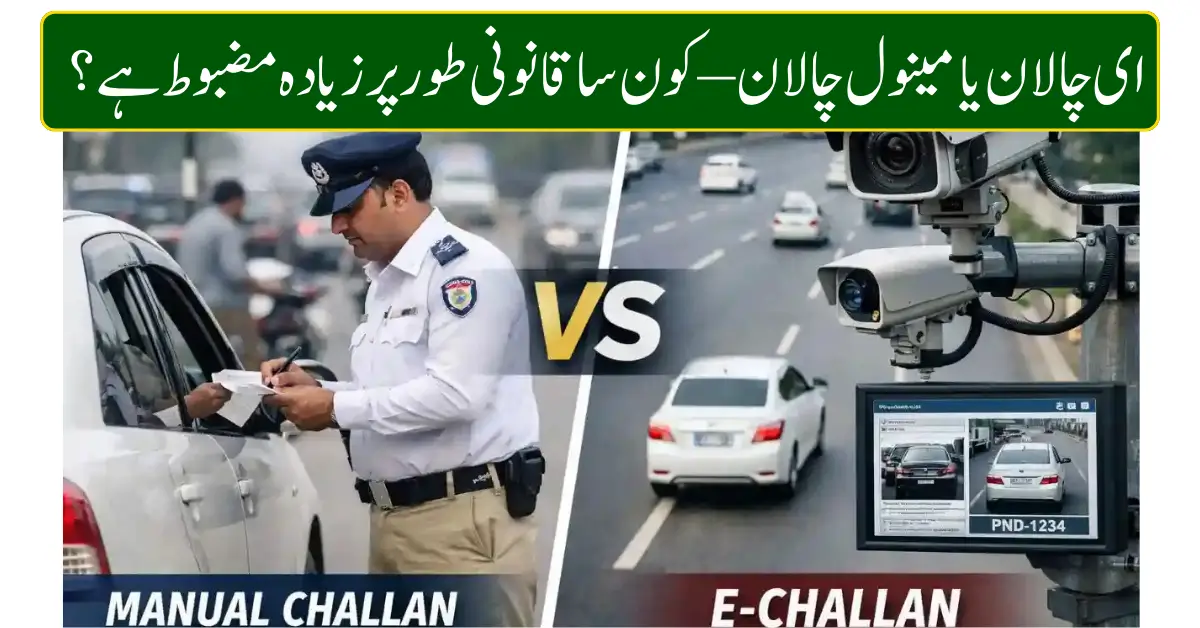
Traffic enforcement in Pakistan has changed dramatically over the past few years. Where handwritten tickets once dominated the roads, e-challans backed by cameras, databases, and digital records are now becoming the norm—especially in Punjab, Islamabad, and other major cities. This shift has raised a common and important legal question for drivers: between E-Challan and Manual Challan, which one is legally stronger?
This in-depth 2026 guide explains the legal standing of both systems, how traffic courts treat them, and why digital enforcement is increasingly favored under Pakistani law.
Understanding the Two Systems
Before comparing legal strength, it’s important to clearly understand how both challan systems work.
What Is a Manual Challan?
A manual challan is the traditional traffic ticket issued directly by a traffic police officer. It is written on the spot, either by hand or through a basic receipt pad.
Core characteristics of a manual challan:
- Issued face-to-face by a traffic officer
- Details written manually (violation, time, place)
- The driver receives a paper copy
- Fine paid at a bank, traffic office, or court
Manual challans have been part of Pakistan’s traffic enforcement for decades and are still legally recognized today.
What Is an E-Challan?
An e-challan (electronic challan) is generated digitally using surveillance cameras, speed cameras, or handheld devices used by traffic police. It is directly linked to official government records.
Key features of an e-challan:
- Issued electronically without stopping the driver
- Supported by photo or video evidence
- Auto-recorded in government systems
- Linked with vehicle registration and CNIC
- Payable online, via banks, or authorized apps
E-challans are now widely used by provincial traffic police departments and city administrations.
Legal Framework Governing Traffic Challans in Pakistan
Both challan types operate under the same legal umbrella, including:
- Provincial Motor Vehicle Ordinances
- Traffic Police Rules and Notifications
- Pakistan’s electronic evidence laws
- Court procedures applicable to traffic violations
Pakistani law recognizes digital records and electronic evidence as admissible, provided authenticity and system integrity are maintained.
E-Challan vs Manual Challan: Legal Strength Comparison
1. Evidence and Proof
E-Challan
- Photo or video evidence
- Time-stamped and geo-tagged
- Stored in official databases
Manual Challan
- Relies on the officer’s written statement
- Usually no visual proof
- Depends on personal observation
Legal edge: E-Challan
2. Human Error and Accuracy
Manual challans are prone to:
- Incorrect vehicle numbers
- Wrong violation codes
- Illegible handwriting
- Missing details
E-challans are:
- System-generated
- Auto-linked with Excise and NADRA records
- Less dependent on human input
Legal edge: E-Challan
3. Acceptance in Traffic Courts
In recent years, traffic courts have increasingly relied on digital documentation.
- Judges prefer objective visual evidence
- Manual challans often require officer’s appearance
- E-challans can stand on a digital record alone
This shift reflects modern judicial reliance on electronic proof.
Legal edge: E-Challan
4. Transparency and Accountability
Manual Challan
- An officer’s discretion plays a major role
- Greater chance of dispute
- Difficult to independently verify
E-Challan
- Automated enforcement
- No direct interaction
- Lower corruption risk
Transparency is a major reason governments favor digital enforcement.
Legal edge: E-Challan
5. Dispute Resolution in Court
When a challan is challenged:
- Manual challan cases usually require officer testimony
- E-challan cases rely on system data and visuals
- Courts treat digital records as primary evidence
Electronic challans reduce subjectivity in legal proceedings.
Legal edge: E-Challan
Is a Manual Challan Still Legally Valid in 2026?
Yes. A manual challan is still fully legal in Pakistan if:
- Issued by an authorized traffic officer
- Properly filled and documented
- Based on a genuine violation
However, legal validity does not equal legal strength. Without strong supporting evidence, manual challans carry less weight in contested cases.
Why E-Challans Are Considered Legally Stronger
The growing preference for e-challans is based on several legal and practical advantages:
- Digital evidence is difficult to manipulate
- Automatic entry into official databases
- Built-in timestamps and location data
- Reduced chances of false accusations
- Consistency across enforcement
These factors give e-challans higher credibility in modern traffic law enforcement.
Can an E-Challan Be Challenged in Court?
Yes, but it is more difficult than challenging a manual challan.
Valid grounds may include:
- Vehicle theft at the time of violation
- Number plate cloning
- Camera malfunction or misreading
- Driver misidentification
In such cases, strong documentary proof is required to counter visual evidence.
Payment Records and Long-Term Legal Impact
Manual Challan
- Payment records may update slowly
- Paper receipts can be lost
- Limited digital trace
E-Challan
- Instant payment confirmation
- Permanent digital record
- Linked to vehicle history
E-challans can affect:
- Vehicle resale clearance
- Token tax verification
- Transfer and biometric processes
Final Verdict: E-Challan vs Manual Challan
| Legal Aspect | E-Challan | Manual Challan |
|---|---|---|
| Evidence Strength | Very Strong | Limited |
| Court Acceptance | High | Moderate |
| Transparency | High | Low |
| Error Risk | Minimal | High |
| Overall Legal Power | ✅ Stronger | ❌ Weaker |
Conclusion
The debate around E-Challan vs Manual Challan is largely settled as Pakistan moves deeper into digital governance. While both systems remain lawful, e-challans are clearly legally stronger due to objective evidence, system-based enforcement, and higher acceptance in traffic courts.
As smart policing expands across provinces, electronic challans represent not just the future of traffic management—but a more transparent and accountable legal process for citizens.
Frequently Asked Questions
Is an e-challan legally recognized in Pakistan?
Yes, traffic courts fully recognize e-challans supported by digital evidence.
Are manual challans easier to cancel?
Yes, they are often easier to challenge due to weaker proof.
Do courts prefer digital challans?
Increasingly yes, because of visual and system-verified evidence.
What happens if an e-challan is unpaid?
Vehicle records may be blocked, and penalties can escalate.
Which system protects citizens more?
E-challans offer greater transparency and reduced misuse.